

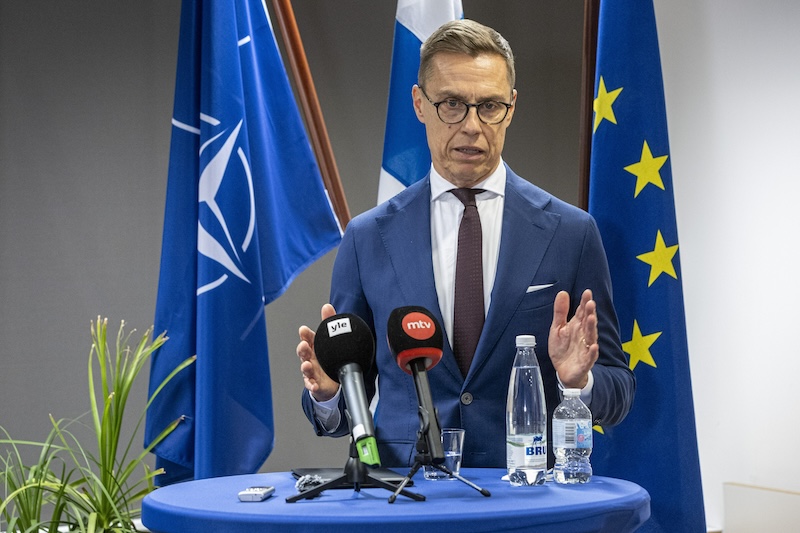
President Alexander Stubb said on Monday that he believes Belgium will eventually support the European Union’s plan to use frozen Russian assets to finance a major support package for Ukraine, despite legal concerns. Stubb made the statement following meetings with senior EU leaders in Brussels, including Belgian Prime Minister Bart De Wever.
The funding mechanism, worth €140 billion, would be structured as a war compensation loan. Ukraine would only repay the EU if Russia pays reparations. The plan is key to covering Ukraine’s looming financial shortfall and maintaining international aid flows.
Belgium has delayed the decision over fears it would bear disproportionate legal and financial risks, since most of the frozen Russian central bank assets are held through Brussels-based clearing house Euroclear. According to Stubb, Belgium’s main concern is being left solely responsible if legal actions follow.
“Belgium does not want to be alone in carrying the burden,” Stubb said, describing his meeting with De Wever as constructive but not definitive.
“Belgium is one of the EU’s founding and most constructive members. I came away with the impression that a solution will be found,” he said, adding that the EU rarely delivers perfect decisions but tends to reach compromise over time.
The European Commission has presented member states with three main funding options: direct contributions from national budgets, issuing joint debt, or leveraging proceeds from frozen Russian assets. A fourth, hybrid model that combines elements from each is now seen as increasingly likely.
“We might see a mix of different instruments,” Stubb said, without confirming whether Finland’s government would accept joint borrowing as part of such a compromise.
Belgium has requested a thorough legal review and risk-sharing guarantees from the European Commission before approving the asset-based model. A decision is expected at the EU leaders’ summit starting on 18 December. The first tranche of aid must be released by March 2026 to ensure Ukraine remains financially stable. The IMF has also made its future support contingent on an EU decision.
Stubb confirmed he spoke with President Volodymyr Zelensky on Friday and that no diplomatic momentum currently supports ceasefire talks.
He added that Russia’s military actions suggest it has no intention to stop the war. “Now is the time to increase pressure on Russia and step up support for Ukraine,” he said.
The Finnish president also noted that the US remains an essential partner. He disclosed details of a conversation held earlier with Senator Lindsey Graham, who is co-sponsoring a new sanctions bill with Senator Richard Blumenthal. Stubb said the proposed package includes heavy trade restrictions targeting countries that continue to buy Russian oil and gas.
The draft legislation, if passed, could impose tariffs of up to 500 percent on imports from countries such as India and China. The goal is to cut off a major revenue source for Russia as peace talks falter.
Stubb said he received indications from Graham that Donald Trump is still interested in ending the war and may support the sanctions package.
“Trump is perhaps the only person who has both the political weight and the leverage over Russia to stop this war,” Stubb said. He added that while peace is unlikely this year, a breakthrough could be possible by spring.
Stubb also warned European leaders against conducting unilateral diplomacy with Russia. He criticised Hungarian Prime Minister Viktor Orbán for maintaining private contacts with the Kremlin, saying such actions undermine EU cohesion.
“If one European leader speaks directly to Russia, the unity breaks, and that’s exactly what Russia wants,” he said.
Stubb reiterated that any US-Russia talks on Ukraine must not bypass Europe. “There will be no discussion over Europe’s head,” he stated.
HT


