

A racism controversy and President Alexander Stubb defined Finland’s global media profile last year, according to a new country image report.
The review shows that while security policy dominated coverage, a single racism scandal generated the largest spike in international attention.
The findings appear in the Finland Promotion Board’s report Finland Through Foreign Eyes 2026, which combines international reputation surveys, media monitoring and observations from Finnish missions abroad.
Foreign media published about 240,000 headlines mentioning Finland or Finns in 2025. That figure stands 60,000 lower than the previous year but remains above the average recorded before 2022.
Security policy remained the central theme for the fourth consecutive year. International outlets focused on Finland’s role on Nato’s eastern flank, its model of comprehensive security and its preparedness in the face of Russia. Coverage often described Finland as a state from which others seek lessons.
Stubb emerged as the most visible Finnish figure abroad. He received around 123,000 mentions in international media, an increase of 75,000 from the year before.
His diplomacy with US President Donald Trump drew wide coverage. Media in several European countries referred to Stubb as a “Trump whisperer” during the year. His involvement in discussions related to Ukraine’s peace efforts also gained attention.
Prime Minister Petteri Orpo ranked second with around 20,000 mentions. Foreign Minister Elina Valtonen followed with 18,600, and Eurovision representative Erika Vikman placed fourth with 15,800 mentions.
Despite the strong focus on security, the single largest media spike concerned a racism scandal late in the year.
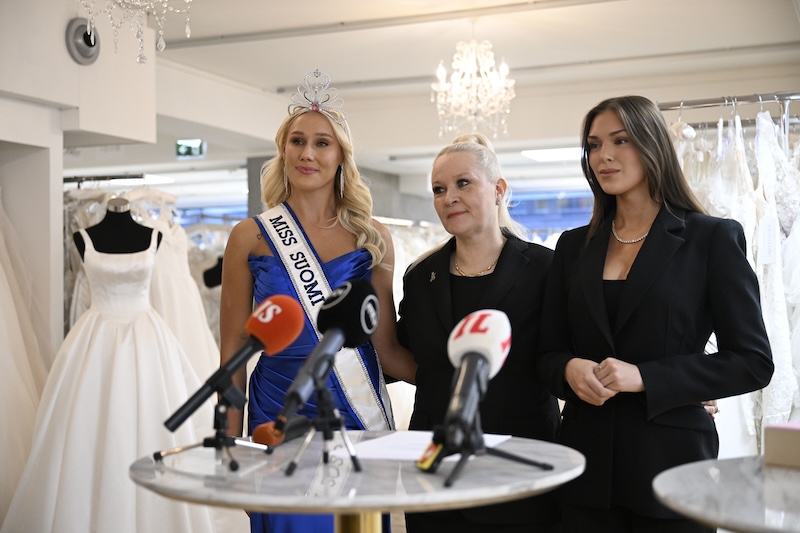
The controversy began after former Miss Finland Sarah Dzafce and several MPs from the Finns Party circulated images widely perceived as racist. The gesture, known internationally as offensive towards Asians, spread rapidly on social media before reaching mainstream outlets.
The story gained most traction in Japan, South Korea and China. In Japan and South Korea, hundreds of articles covered the issue, including reports on prime-time television news broadcasts. In China, discussion spread widely online and on the Weibo platform.
According to the report, tens of thousands of social media comments linked Finland with racism during the episode.
The backlash prompted Orpo to issue formal apologies in Chinese, Japanese and Korean.
While the racism controversy generated the sharpest peak, most coverage of Finland remained neutral or positive.
Reputation surveys cited in the report show that Finland retains strong associations with nature, good governance, equality, education and human rights. In a comparison of 60 countries among residents of G7 states, Finland ranked fifth, behind Switzerland, Canada, Norway and Sweden.
The Anholt Nation Brands Index recorded a rise in Finland’s overall score and a two-place increase in familiarity among 50 countries surveyed. Finland now ranks 35th in recognition, still below the survey average.
Education and happiness featured frequently in foreign reporting. Media referenced Finland as a model in schooling, including its decision to restrict smartphone use during primary school lessons. Articles about Finland’s repeated ranking as the world’s happiest country cited security, trust, equality, healthcare, social protection and sauna culture.
Beyond politics, sport delivered visibility. Motor racing drivers Valtteri Bottas and Kalle Rovanperä, basketball player Lauri Markkanen and ice hockey players Mikko Rantanen and Aleksander Barkov featured widely in North American media. Coverage of a hockey tournament involving Finland also reached audiences in the United States and Canada.
Cultural references remained present but less prominent. The 80th anniversary of the Moomins generated stories in Europe and the United States, including an exhibition in New York. Eurovision coverage brought attention to Vikman’s performance across Europe.
Foreign outlets also reported on domestic social challenges. Articles in Japan, Iran and Romania examined Finland’s mental health statistics, drug issues and public finances, often contrasting these topics with its image as a content society.
The report concludes that Finland’s international profile has shifted towards a stronger security role in Europe. At the same time, a single controversy demonstrated how quickly reputational damage can spread across continents.
HT


