

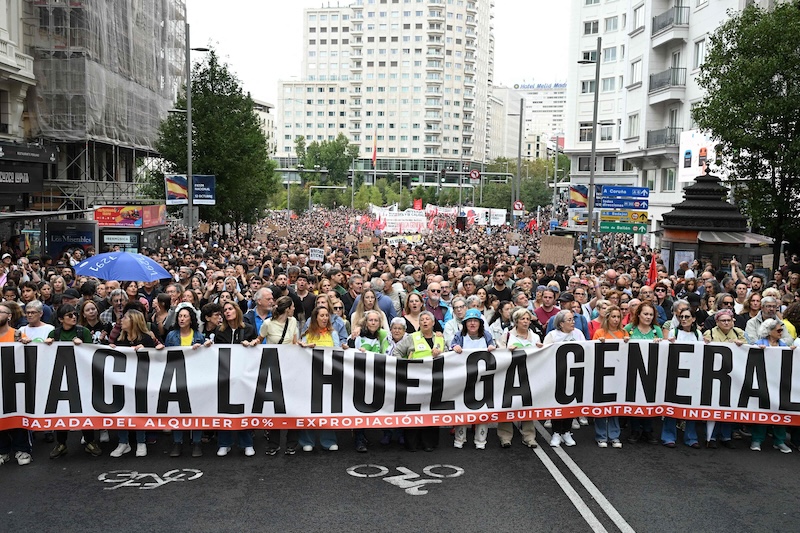
Tens of thousands of people marched in Madrid and other Spanish cities on Saturday to demand action on housing, a day after parliament rejected two government decrees covering evictions, rental contracts and property investment. The protests followed weeks of public anger over rising housing costs and the eviction of an 87-year-old Madrid resident.
Spain's government said about 70,000 people attended the Madrid demonstration. The city's Tenants' Union gave a figure of 500,000. The estimates could not be independently reconciled.
Around 50 demonstrations had been planned across the country. Protests in Barcelona and nearby L'Hospitalet de Llobregat were cancelled because of heavy rain, Reuters reported.
In Valencia, protesters clashed with police near the City of Arts and Sciences, where a property event was taking place. Reuters reported that police used rubber bullets and tear gas after about 30 demonstrators entered the complex. Other demonstrations were reportedly peaceful.
The protests followed Friday's defeat of two housing decrees proposed by the minority coalition government led by Prime Minister Pedro Sánchez.
MPs rejected the first decree by 178 votes to 172 and the second by 184 to 166. The conservative People's Party, Vox and the Catalan pro-independence Junts opposed both measures.
The proposals included a suspension of evictions involving vulnerable tenants until 2030, extensions to some rental agreements, measures affecting tourist accommodation and restrictions on purchases by investment funds. A separate decree included automatic renewal of rental contracts.
Juan Bravo of the People's Party defended his party's opposition by arguing that increasing supply offered the route to lower housing costs. "Housing doesn't get cheaper with decrees, it gets cheaper with more homes," he said during the parliamentary debate.
Junts lawmaker Miriam Nogueras argued that the measures had been prepared without enough rigour and would fail to prevent investment funds from buying homes or stop evictions.
The protest movement expanded after Maricarmen Abascal, 87, was evicted from the Madrid flat where she had lived for about 70 years. Accounts differ over the size of the rent increase she faced, with the supplied reports putting the rise between 230% and 275%. Following protests, the company that owns the flat reached an agreement allowing her to return at a lower rent.
Housing campaigners have continued demonstrations despite that agreement. The Tenants' Union is seeking talks with trade unions over a general strike, spokeswoman Valeria Racu told reporters in Madrid.
Housing costs have risen as construction has failed to keep pace with demand. The Bank of Spain estimates a shortage of about 700,000 homes. National statistics agency INE recorded a 12.2% annual rise in house prices in the second quarter of 2026.
The parliamentary defeat also exposed the limits of Sánchez's minority coalition. His Socialist Party and junior coalition partner Sumar need support from smaller parties to pass legislation.
Spanish media reported that Sánchez was considering an early election following the vote. Opposition leader Alberto Núñez Feijóo called on the prime minister to hold an election "as soon as possible".
HT


