

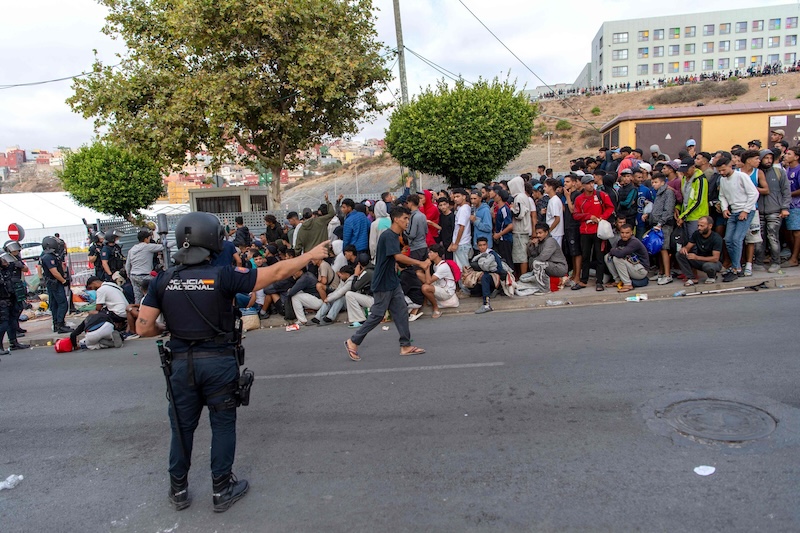
The European Parliament has called for stronger protection of the EU’s external borders and closer cooperation with Morocco after mass irregular crossings into the Spanish city of Ceuta, where 141 people died at sea during events on July 30 and 31.
Lawmakers adopted the resolution on Thursday by 339 votes to 225, with 16 abstentions. The text described Ceuta and Melilla as Spanish and European cities and called for their territorial integrity to be respected.
The resolution follows the Ceuta crisis and comes a day after European Commission President Ursula von der Leyen announced plans for a new mechanism covering mass movements of migrants that authorities regard as engineered or weaponised.
Ceuta authorities and the Spanish government linked the initial mobilisation to a Spanish Supreme Court ruling concerning people who reach the territory by sea. The decision required legal procedures before such migrants were returned to Morocco. Social media posts subsequently presented the ruling as meaning that people who swam into Ceuta would be allowed to remain.
Spanish Prime Minister Pedro Sánchez said criminal trafficking networks exploited and distorted the ruling to encourage people to travel to the border. Reporting found that messages giving routes, crossing advice and information about boats and swimming equipment spread through social media networks in several countries.
Questions were also raised over whether Morocco had deliberately allowed the movement as political pressure on Spain, including over Madrid’s closer relations with Algeria. Morocco claims Ceuta and Melilla, while Spain regards both as sovereign Spanish territory.
Sánchez later said Spanish intelligence agencies had found no evidence that the Moroccan government organised the crossings. He described cooperation with Rabat as necessary to resolving the crisis.
Sánchez separately accused accounts linked to Russia, Israel and international far-right networks of spreading or amplifying false information about the crisis. Israel rejected the accusation, while the Kremlin also denied Russian involvement.
The Parliament expressed sorrow over the 141 deaths and described the loss of life as preventable. At the same time, lawmakers condemned what the resolution called the instrumentalisation of irregular migration as a form of hybrid warfare against an EU member state.
MEPs called on Spain to strengthen its police and security presence in Ceuta and make full use of emergency assistance from the European Commission and operational support available through EU agencies.
The resolution also called for more funding for external border infrastructure and stronger Frontex capabilities.
MEPs criticised Spain’s large-scale regularisation policy, saying in the resolution that the measure acted as a pull factor and sent the wrong signal to prospective migrants and smuggling networks. Parliament asked the Commission to assess the effects of national regularisation programmes on movement between EU countries and the Schengen area.
The Parliament also urged Spain and Morocco to increase cooperation on returns and readmission. It said people without a right to remain in the EU should face prompt return procedures in accordance with EU and international law.
The EU’s Pact on Migration and Asylum has applied in full since June 12. The rules include procedures covering sudden migration pressures and cases in which third countries instrumentalise migrants, as well as provisions for faster asylum and return procedures in crisis situations.
The Parliament called on Morocco to meet its commitments on border security, migration and readmission. It also said relations between the EU and third countries should link access to EU funding and markets with cooperation on border management, migrant smuggling and returns.
Commission President Ursula von der Leyen announced a separate European Emergency Response Framework during her State of the Union address in Strasbourg on Wednesday.
“The events of this summer show that our tools need to evolve, especially for emergency situations,” von der Leyen said. She said the framework would apply under defined criteria and permit temporary flexibility in standard procedures.
Von der Leyen specifically referred to Ceuta while setting out the plan, telling Spain that “Ceuta’s border is a European border”. She also said the Commission intends to strengthen Frontex, accelerate returns and improve early-warning systems with countries outside the bloc.
The Commission has not yet presented the detailed legislative proposal for the emergency framework.
HT


