US President Donald Trump has threatened new tariffs on the European Union after Canada welcomed a proposal for closer ties with the bloc, including a new form of associate membership.
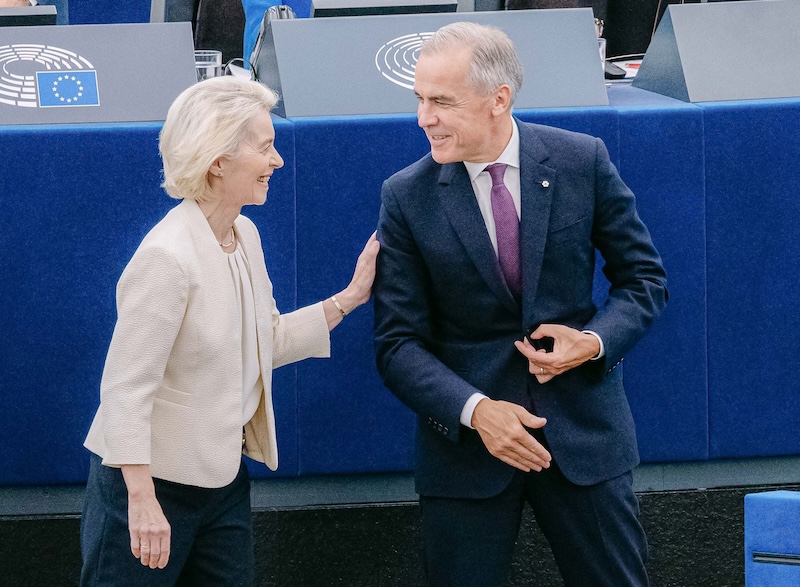
The dispute emerged as Canadian Prime Minister Mark Carney told the European Parliament that Ottawa wanted deeper cooperation with Europe on trade, defence, energy, technology and critical minerals.
Trump described the European Commission proposal as “laughable” and said Washington would respond if he regarded the plan as hostile.
“If they do that, if I think it’s at all a hostile act, I will put very serious tariffs or stop trading with Europe on many things,” Trump told reporters while travelling to North Carolina. He said the US response would depend on what he regarded as Europe’s intention.
European Commission President Ursula von der Leyen proposed opening the door to Canada becoming the EU’s first “associate member” during her State of the Union address in Strasbourg on Wednesday.
No such membership category exists under current EU treaties. Any new arrangement would require agreement among EU governments, while its legal structure, rights and obligations have yet to be defined. The EU has previously resisted informal membership structures outside its established accession system.
The Commission rejected the suggestion that the initiative targeted Washington. Its spokesman Olof Gill said von der Leyen had presented the partnership as a measure designed to strengthen Canada and Europe rather than act against another country.
France also rejected any US role in determining European foreign policy.
“It is not up to the United States — or anyone else — to choose the political and geopolitical direction of the Europeans,” French Europe Minister Benjamin Haddad told Public Sénat.
Carney used his address to the European Parliament on Thursday to welcome the Commission’s proposal.
“Canada welcomes this ambition,” he said, describing the prospective relationship as “an alliance for the future” that Ottawa and Brussels would define together.
He called for cooperation covering critical minerals, defence production, artificial intelligence, computing capacity, energy, space, payment systems and industrial policy. He also proposed closer digital trade and easier movement for students and young workers, including Canadian participation in the Erasmus+ exchange programme and the EU’s Horizon research programme.
Carney said closer links would reduce strategic dependence at a time when governments face pressure through tariffs, supply chains and financial systems.
“Europe and Canada are stronger together,” he told lawmakers.
His comments came after Canada-US trade negotiations broke down and both governments imposed tariffs on billions of dollars of goods. Ottawa has sought to reduce its economic reliance on the United States while expanding trade and security relations with Europe.
Canada and the EU already operate under the Comprehensive Economic and Trade Agreement, known as CETA. Ten EU member states have yet to complete ratification of the agreement, underlining the political hurdles facing any broader institutional arrangement.
Carney said the proposed alliance was not intended to create a new power bloc to compete with the United States, China or other major economies. He said the objective was to give participating countries greater control over their economic and security choices.
Questions also remain inside the EU
Reuters reported that one EU diplomat said “nobody really knows what it means”, while another diplomat described von der Leyen’s announcement as an “unfortunate proposal” that had not been discussed with member states. The comments point to disagreement over both the terminology and the process behind the plan.
European Parliament President Roberta Metsola said the concept could eventually provide a framework for closer relations with other countries, including Australia and New Zealand. She said stronger links with Canada should not be treated as a measure directed against another state.
The next stage will depend on negotiations between Ottawa, the Commission and the EU’s 27 governments over what an associate relationship would contain and whether governments are prepared to create a status that does not exist under the bloc’s present membership system.
HT