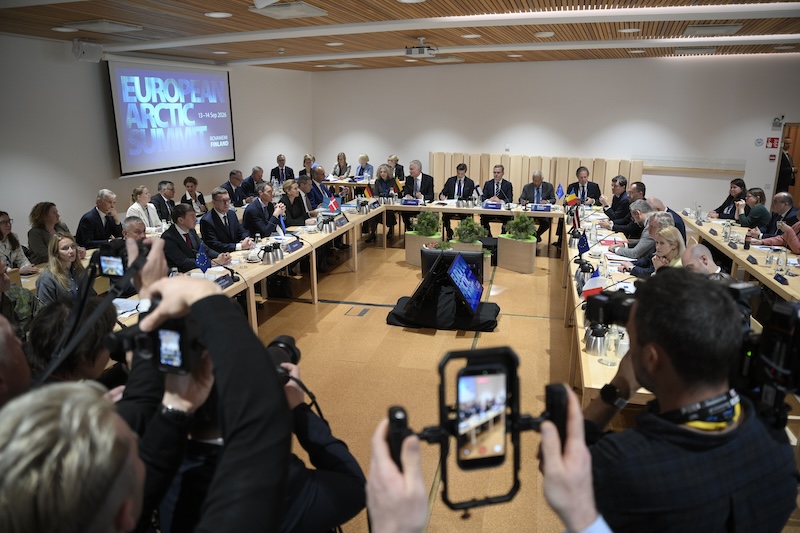
European leaders meeting in Rovaniemi have backed a stronger EU role in the Arctic, with Finland pressing for joint icebreaker capacity, more investment in northern infrastructure and a coordinated response to Russian pressure in the region.
Prime Minister Petteri Orpo received support for the icebreaker proposal from German Chancellor Friedrich Merz, who said Europe needed more such vessels and that Finland had Germany’s backing to advance the idea jointly.
The summit brought together leaders from Germany, Denmark, Estonia, Latvia, Lithuania, Romania and several EU institutions as the bloc prepares an updated Arctic strategy.
Merz said icebreakers were not only a Finnish or Nordic concern but a wider European requirement.
EU foreign policy chief Kaja Kallas also said there was broad support at the meeting for expanding icebreaker capacity, though she stressed that EU procurement rules would still apply and contracts would go to the strongest bid.
Finland has said it wants to build and host possible EU-funded vessels, an area where Finnish shipyards have long specialised.
Leaders also called for more investment in military mobility, cross-border transport links, satellite infrastructure and other northern facilities.
The summit’s joint statement said Russia’s efforts to increase its influence in the Arctic, combined with hostile activity against Europe, had increased the need for a stronger EU policy in the region.
The Arctic is gaining economic and security significance as melting ice opens new routes and access to raw materials. The shift has drawn more attention from Russia, China, the United States and European countries.
Orpo also warned that Russia was becoming more aggressive and moving its attacks closer to European borders.
The summit took place a day after a Russian drone struck a train near the Polish border in Ukraine, an attack several leaders described as part of a broader effort to intimidate Europe.
Kallas said the strike was clearly intended as a message to Western countries.
Denmark’s Prime Minister Mette Frederiksen also addressed tensions over Greenland and said talks with the United States were continuing through a high-level working group.
She said it was too early to draw conclusions but added that she was “quite optimistic” that a peaceful solution would be found.
European Council President António Costa said the EU had repeatedly expressed full support for Denmark. He also pointed to plans to increase EU investment in Greenland under the bloc’s next long-term budget.
The summit was designed to influence the European Commission’s revised Arctic strategy, which is expected in the coming weeks. The EU’s previous strategy dates from 2021.
Finland has argued that the new policy should give greater weight to defence, transport links, critical infrastructure and economic development in the High North.
Orpo said the Arctic and Baltic regions had become central security areas for Europe and argued that the EU would need to direct more funding towards northern projects.
German Chancellor Merz also used the meeting to stress continued support for Ukraine despite political pressure inside Europe.
He said the coming weeks and months would be critical for defending peace and freedom in Europe and said he was not prepared to retreat from Germany’s support for Kyiv.
HT