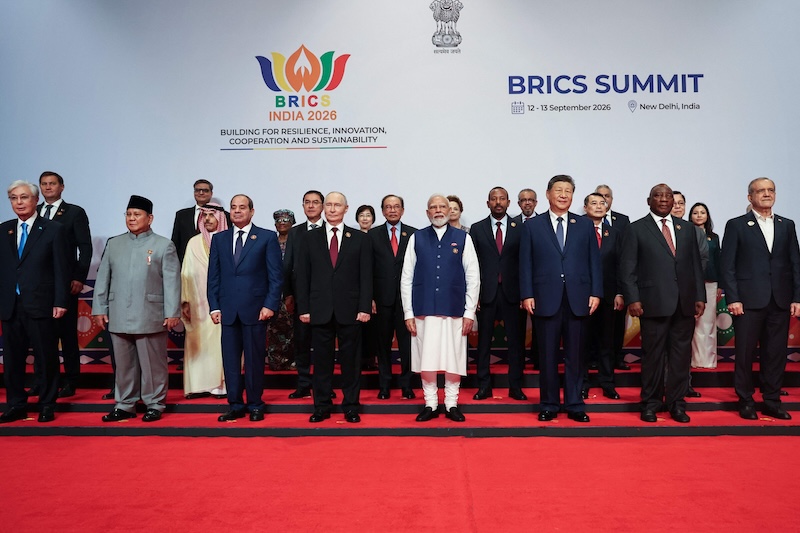
Chinese President Xi Jinping has placed the idea of BRICS nations acting as “pioneers” at the centre of his message to the 18th BRICS Summit in New Delhi, setting out a programme based on innovation, peace, exchanges between civilisations and reform of global governance.
Addressing the first session of the summit on 12 September, Xi said the BRICS cooperation mechanism had developed over two decades into what he described as the world’s most influential platform for cooperation among emerging markets and developing countries.
He presented its growth as evidence that countries of the Global South had built an institution around cooperation, national development choices and common interests.
The summit marks 20 years since the start of BRICS cooperation. Xi used the anniversary to look beyond the organisation’s expansion and set out a role for the grouping in the next phase of international affairs.
His central message was that BRICS members should “strive to be a pioneer of the times” as economic and political weight shifts towards emerging economies and developing states.
The phrase was not presented as a slogan in isolation. Xi linked the idea of pioneering action to four fields in which he wants BRICS members to take a larger role: innovation-driven development, peace and stability, exchanges between civilisations and reform of global governance.
Xi first called on BRICS to pioneer innovation-driven development. His proposal placed artificial intelligence, industrial development and technological cooperation near the centre of the group’s economic agenda.
He urged BRICS members to strengthen cooperation in artificial intelligence, support open-source development and pursue greater sharing between members. China also proposed an initiative to promote new industrialisation through artificial intelligence among BRICS countries.
Xi said China wanted to work with other members on research, development and application while strengthening cooperation across industrial and supply chains. He also invited BRICS countries to take part in the World Artificial Intelligence Cooperation Organization.
The focus moved from broad principles to a more detailed programme during the second day of the summit on 13 September.
Xi proposed five initiatives for what he called “greater BRICS” cooperation. They cover artificial intelligence, trade and investment facilitation, the digital industry, smart manufacturing and talent development.
He said “greater BRICS” should produce greater impact, pursue greater development and establish a foundation for practical cooperation. He called for members to draw on their position in emerging markets and their links with the Global South while supporting open cooperation, stable industrial and supply chains and more integrated markets.
Xi also called for innovation incubators, the upgrading of traditional industries, the development of emerging sectors and planning for future industries.
Taken together, the proposals give more definition to his call for BRICS members to serve as pioneers. The first part of the programme focuses on moving emerging economies from users of new technologies towards a larger role in research, industrial application and standard-setting.
That approach carries weight because BRICS has expanded far beyond its original format.
BRICS is now an 11-member organisation spanning four continents, with a wider group of partner countries taking part in cooperation. BRICS members now represent close to half of the world’s population.
Expansion has also changed the position of Africa within the organisation. South Africa is joined by Egypt and Ethiopia as full members, giving the continent three seats within the grouping.
This gives African states a larger role in shaping international rules rather than participating only in systems created elsewhere.
Xi’s second call for pioneering action dealt with peace and stability.
He urged BRICS members to support what China describes as common, comprehensive, cooperative and sustainable security. He opposed Cold War thinking, bloc confrontation, interference in other states’ internal affairs and violations of national sovereignty.
He also called for BRICS to take a constructive role in resolving conflicts and disputes.
The Middle East featured directly in his remarks. Xi said the conflict in the region had caused serious losses and ran against the common interests of the international community. He called for political settlement and a permanent and comprehensive ceasefire and said China would work with other BRICS members in support of peace in the region. citeturn463152view0
This part of Xi’s “pioneer” concept gives BRICS a political role alongside its economic work.
The organisation began as a forum centred on emerging economies. Its agenda now extends to questions of security, international institutions, technology, trade and development. Xi’s speech presented that wider agenda as a responsibility that follows from the increased economic and demographic weight of BRICS members.
His third call was for BRICS to become a pioneer in mutual learning between civilisations.
Xi urged the group to support exchanges between countries and societies, expand cooperation in culture, tourism and education and strengthen contact between young people and called on members to exchange experience in governance and use cultural and people-to-people programmes to support stable relations between states.
This part of the speech placed human contact alongside trade, finance and technology.
For a group spanning Asia, Africa, the Middle East and Latin America, internal diversity is one of its defining features. Xi’s approach treats those differences as a basis for exchange rather than an obstacle to cooperation.
His fourth call for pioneering action addressed global governance.
Xi urged BRICS members to support reform of international institutions and push for what he described as a more just and equitable global governance system.
He called for support for the authority of the United Nations, a multilateral trading system centred on the World Trade Organization and opposition to protectionism.
Xi also identified cyberspace, outer space and the deep sea as fields where BRICS members should take a greater part in setting rules and shaping governance. He linked that role to increasing the voice of Global South countries in international decision-making.
The four uses of “pioneer” give Xi’s summit speech a consistent structure.
Pioneering in innovation means building technological capacity. Pioneering in peace means taking a larger role in political settlement and opposing bloc confrontation.
Pioneering in exchanges between civilisations means expanding contact between societies.
Pioneering in global governance means seeking a greater role for emerging and developing countries in international institutions.
The second-day proposals then add an economic mechanism to that framework through AI, trade, digital industry, manufacturing and skills.
A larger membership gives the organisation a broader economic base and wider geographic reach. It also brings together governments with different political systems, economic structures and national priorities.
At the summit, participating leaders also backed a stronger role for BRICS in representing the Global South. Participants supported multilateralism, the central role of the United Nations, sovereign equality, international law and free trade while calling for joint responses to international challenges.
The leaders adopted a joint declaration that set out their shared positions on development, security, economic cooperation and global governance. The declaration reaffirmed support for multilateralism, international law and the central role of the United Nations, while calling for greater representation of emerging markets and developing countries in international institutions. The members backed an open, inclusive and non-discriminatory multilateral trading system centred on the World Trade Organization and opposed protectionism. They also committed to deeper cooperation in areas including trade, investment, finance, technology, artificial intelligence and sustainable development. The declaration reflected the summit’s wider message that BRICS members intend to strengthen coordination among themselves while giving the Global South a larger voice in decisions that shape the international economic and political system.
China will take over the rotating BRICS chair and host the 19th BRICS Summit in 2027. Xi said Beijing wanted to work with all parties to build consensus and begin what he termed BRICS’ third “golden decade”.
That handover gives China responsibility for turning parts of the New Delhi agenda into working programmes.
The five initiatives announced on the second day provide an early indication of where that effort is heading. AI cooperation links research with industrial development. Trade and investment facilitation seeks to strengthen economic connections. Digital industry and smart manufacturing address changes in production. Talent development focuses on the workers and specialists required to support those sectors.
The wider Global South context gives these proposals significance beyond the organisation itself.
For BRICS, the next test is whether expanded membership leads to expanded practical cooperation.
Xi’s speeches in New Delhi set out China’s answer.
BRICS should not limit itself to responding to changes in the international system. Its members should seek to shape those changes.
By repeatedly describing BRICS nations as prospective “pioneers”, Xi assigned the grouping a forward role rather than a defensive one. His four-part framework links that role to technology, security, cultural exchange and institutional reform, while the “greater BRICS” proposals give the programme an economic and industrial base.
As China prepares to assume the BRICS chair, the New Delhi summit has placed that idea at the centre of the organisation’s next phase: emerging and developing countries acting together not only as participants in international affairs, but as states seeking to help set their direction.
HT