


There's a quiet revolution happening in video production, and it doesn't involve cameras, studios, or expensive post-production teams. It involves feeding your existing footage into an AI model and getting something fundamentally better — or at least fundamentally different — back out. Video-to-video AI has matured fast, and the people paying attention are already using it to do things that would have required a full production pipeline twelve months ago.
This isn't about replacing creativity. It's about eliminating the friction between having a good idea and executing it at the quality level your audience expects.
The Problem With Existing Footage (And Why Reshooting Is Usually Off the Table)
Anyone who works with video content at scale knows the sinking feeling of reviewing footage that's almost right. The lighting is slightly off. The background doesn't match the aesthetic of the campaign it's supposed to support. The original was shot for one platform and now needs to work on another with completely different format expectations. The corporate training video from 2022 is still accurate but looks dated enough that employees are quietly ignoring it.
The traditional answer to all of these problems is "reshoot." And the traditional response to "reshoot" is "we don't have the budget, the time, or the location anymore." So the slightly-wrong footage gets used anyway, or the dated training content sits on the LMS gathering digital dust, or the platform-specific optimization just doesn't happen.
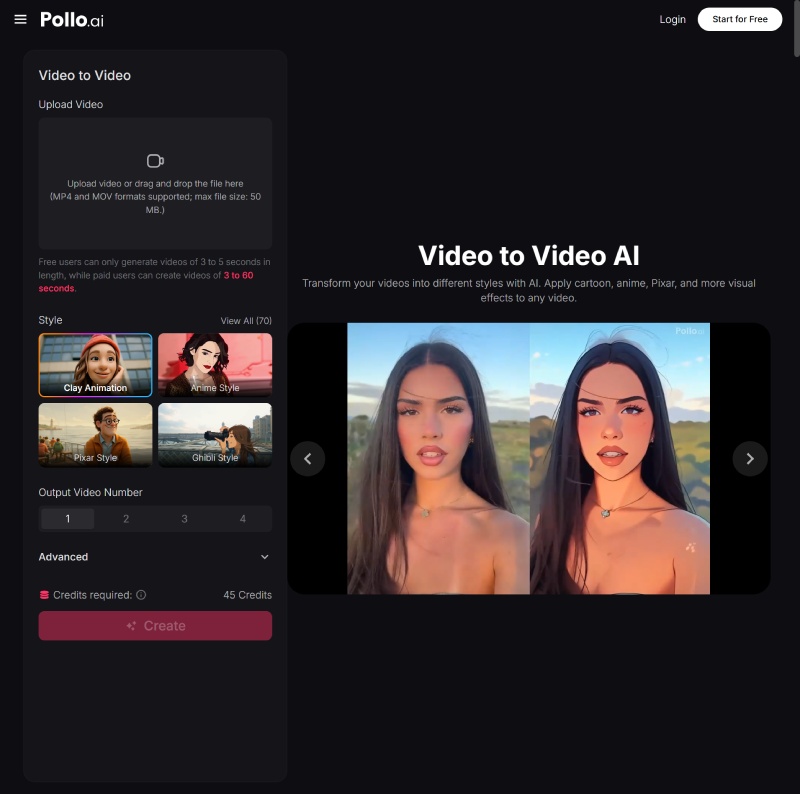
Video to video AI changes the calculus here significantly. Rather than treating existing footage as a fixed asset that can only be trimmed and cut, Pollo AI's video-to-video tool treats it as a starting point that can be transformed — restyled, reformatted, re-atmosphered — through AI processing. The source footage provides the motion, the timing, and the structural logic of the scene. The AI applies a new visual layer on top, producing output that can be radically different in aesthetic register while maintaining the underlying action that makes the footage useful. Pollo AI has built this specifically for production workflows where reshooting isn't a realistic option but the existing footage isn't quite where it needs to be.
What "Video to Video" Actually Means in Practice
The term covers more specific use cases than it might initially suggest, and understanding the range helps identify where it delivers the most value in a given workflow.
Style transfer is the most visually dramatic application — changing the aesthetic treatment of footage from one register to another. Corporate footage shot in a flat, neutral style can be given a cinematic color grade and lighting treatment. Consumer-shot product footage can be elevated to a brand campaign aesthetic without a reshoot. Marketing content produced for one visual identity can be adapted to a new brand direction without rebuilding from scratch.
Format conversion with intelligent reframing addresses the platform fragmentation problem that has become a permanent feature of content distribution. Horizontal 16:9 footage converted to vertical 9:16 through simple cropping loses compositional intent — the important visual information is usually centered in a horizontal frame, and cropping to vertical leaves you with a narrow slice of what was there. AI-powered format conversion understands what's important in the frame and recomposes accordingly rather than simply cropping.
Background replacement and environmental modification allows footage shot in one context to be placed in another. A product demonstration shot in a generic office environment can be placed against a more aspirational or brand-appropriate background. Training footage shot in a dated physical environment can be updated without reshooting the presenter.
Quality enhancement and upscaling extends the useful lifespan of older footage. Archive material, older marketing assets, and content shot on earlier-generation equipment can be processed to match the resolution and quality expectations of current platforms and displays.
Where Deevid AI Fits Into the Picture
The video-to-video transformation layer handles the existing footage problem. The complementary challenge is producing new video content at the volume and variety that modern content operations require — without a proportionally large production investment.

Deevid AI, accessible through Pollo AI, approaches this from the generation side rather than the transformation side. It creates video content from scripts, briefs, and visual references without requiring original footage as input, which makes it the natural counterpart to video-to-video transformation in a complete content workflow. Where video-to-video maximizes the value of footage you already have, Deevid AI fills the gaps where you need new content that doesn't exist yet. Pollo AI offering both capabilities within the same ecosystem means content teams can move between transformation and generation depending on what a given project requires, without managing separate tool sets for adjacent production tasks.
The combination is particularly useful for content operations that are simultaneously maintaining legacy assets and producing new material — which describes most organizations with any significant video history.
The Organizational Use Case That Doesn't Get Enough Attention
Most coverage of AI video tools focuses on the creator economy use case — individual content producers building audiences on YouTube or social platforms. The organizational use case is arguably more significant and considerably less discussed.
Large organizations are sitting on libraries of video content that represent substantial production investments but are underperforming because they were produced for contexts that no longer exist. Brand campaigns from previous visual identities. Training content produced for in-person delivery that needs to work in remote environments. Product documentation shot for hardware that has since been updated. Sales enablement content that reflects a messaging architecture that has evolved.
Replacing all of this content through traditional production would require budgets and timelines that most organizations can't justify. Leaving it in place means communicating with content that doesn't reflect current standards, current brand positioning, or current audience expectations. Video-to-video AI introduces a third option: systematic transformation of existing content to bring it up to current standards, at a fraction of the replacement cost.
This isn't a hypothetical efficiency gain. It's a concrete operational change that shifts the question from "can we afford to update this content" to "in what order do we update it."
What to Evaluate When Building a Video-to-Video Workflow
For teams looking to implement video-to-video AI seriously rather than experimentally, a few evaluation criteria consistently separate tools that work in production from tools that work in demos.
Output consistency across a batch matters more than peak output quality in a single generation. A tool that produces stunning results for three out of ten clips and inconsistent results for the other seven creates more work than it saves. Before committing to a workflow, test the tool against your actual content variety — different lighting conditions, different subjects, different source qualities — rather than against ideal test cases.
Processing time relative to your distribution cadence determines whether the tool actually fits in your workflow. Real-time isn't necessary for most use cases, but a tool that requires hours per clip for a team publishing daily creates a bottleneck rather than removing one.
Export format flexibility affects how much additional work happens downstream. Tools that output in the specific formats and resolutions your distribution channels require save the transcoding and reformatting steps that otherwise consume the time the AI processing was supposed to free up.
Integration with existing asset management is the enterprise consideration that often determines whether a promising tool actually gets adopted. Video-to-video AI that requires manual asset export and re-import for every clip adds friction that accumulates into real overhead at scale. Even basic workflow integration — drag-and-drop batch processing, folder monitoring, API access — can make the difference between a tool that gets used consistently and one that gets used enthusiastically for a month and then quietly abandoned.
The underlying capability is genuinely useful. The implementation details determine whether that capability translates into the workflow improvement it promises.


