

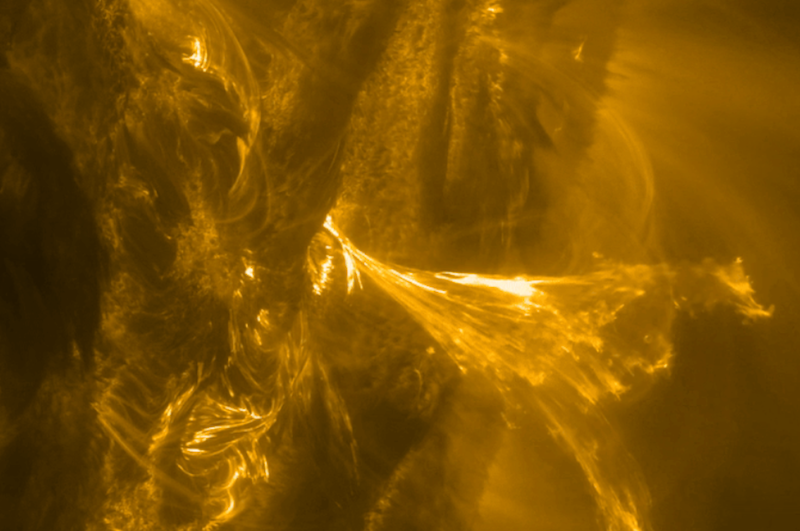
A large-scale simulation by the European Space Agency (ESA) has revealed the full threat posed by a solar storm equivalent to the 1859 Carrington Event.
The test, conducted at ESA’s mission control in Darmstadt, involved a simulated X45-class solar flare and its cascading impact on satellites and Earth-based infrastructure. The scenario assumed a worst-case event, causing real-time system failures and exposing the vulnerability of modern technology.
The simulated storm unfolded in three stages.
First, radiation from the flare would reach Earth in eight minutes, disrupting communications, navigation signals and radar.
Next, within 20 minutes, a wave of high-energy particles would strike orbiting satellites. These particles, including protons and electrons, would damage or destroy sensitive components. ESA scientists said some onboard systems would fail permanently.
Finally, 10 to 18 hours later, a coronal mass ejection (CME) would hit Earth's magnetic field. The CME would drive a geomagnetic storm, disrupting the power grid, overloading transformers and accelerating the decay of satellite orbits due to swelling in the upper atmosphere.
ESA’s Thomas Ormston, Deputy Spacecraft Operations Manager for the Sentinel-1D satellite, said in a statement, “Should such an event occur, there are no good solutions. The goal would be to keep the satellite safe and limit the damage as much as possible.”
The Sentinel-1D mission, valued in the tens of millions of euros, is scheduled for launch on 4 November. It is designed to provide constant Earth surface imagery. Engineers acknowledge that shielding it from a Carrington-scale event is not possible.
The ESA described the simulation as a critical stress test.
Gustavo Baldo Carvalho, Lead Simulation Officer, said the team understood the challenge once the simulation began. “Once they regained composure, they knew a countdown had begun. In the next 10 to 18 hours, a coronal mass ejection would strike, and they had to brace for it.”
The last known Carrington-level solar storm occurred in August 1859. It caused auroras as far south as Central America and ignited telegraph paper in North America. If a similar storm struck today, it would affect nearly every satellite system and major infrastructure linked to electricity and communication.
ESA scientists estimated that satellite drag could rise by 400 percent during the CME phase. This would increase collision risk, reduce satellite life spans and degrade GPS accuracy.
Jorge Amaya, ESA’s Space Weather Modelling Coordinator, said, “Satellites in low-Earth orbit are typically better protected, but an explosion of the magnitude of the Carrington event would leave no spacecraft safe.”
The test also focused on the Sentinel-1D mission’s vulnerabilities. The satellite’s primary function is to monitor Earth, but in the case of a geomagnetic storm, its electronics would fail within minutes of exposure to charged particles.
ESA’s broader plans to mitigate space weather risk include the Distributed Space Weather Sensor System (D3S), which will deploy new monitoring satellites. In parallel, ESA is preparing the Vigil mission, scheduled for launch in 2031. Vigil will observe the sun from a side angle at the Earth-Sun L5 point, offering earlier warnings than currently possible.
The ESA’s Space Weather Office supervised the simulation and said the exercise tested every level of response. From mission control to satellite operations, staff were required to make decisions under realistic conditions with limited information.
ESA has warned that the possibility of another Carrington-level event is not theoretical.
“It's not a question of if this will happen but when,” Carvalho said.
The simulation modelled the triple strike of solar energy—radiation, high-energy particles and coronal plasma—as a near-total systems failure event. On the ground, geomagnetically induced currents could surge through power lines, pipelines and transformer systems, triggering blackouts and equipment failure.
An earlier incident in 2012 nearly resulted in a direct hit from a similar storm. NASA scientists later confirmed that the Earth missed the blast by nine days. ESA’s researchers have classified that near-miss as a critical warning.
The ESA’s latest actions come amid rising solar activity. On 11 May 2024, a strong aurora was visible across Finland after a geomagnetic event, sparking renewed interest in solar monitoring efforts. This event was minor compared to the Carrington scenario, but it served as a visible reminder of what solar storms can trigger.
HT


