

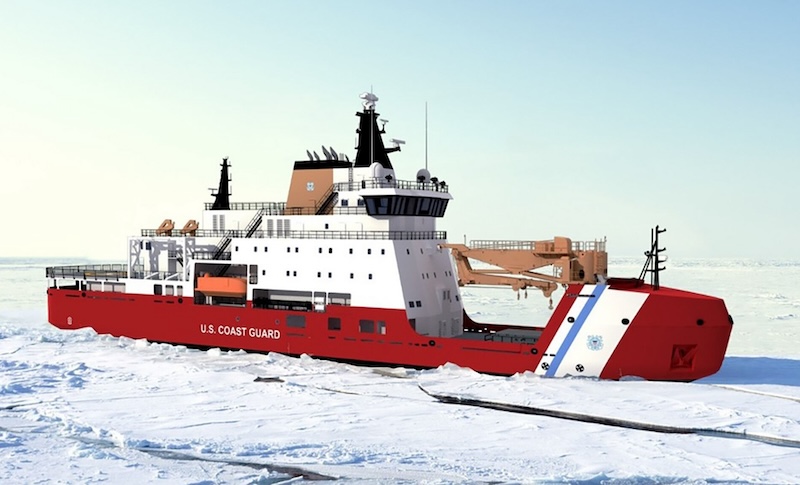
Finland’s Rauma Marine Constructions has signed a confirmed contract with the United States Coast Guard to build two medium-sized Arctic Security Cutter icebreakers by 2028.
The vessels will be constructed at the Rauma shipyard in western Finland. The agreement follows a broader bilateral arrangement between Finland and the United States, finalised in October, to supply a total of eleven icebreakers. Four will be built in Finland and seven in the United States.
Of the four Finnish-built ships, two are set to be constructed in Helsinki and two in Rauma.
Construction work at Rauma will begin immediately. Preparatory operations had already started in the autumn, according to the company. The deal marks the start of full-scale production.
Rauma Marine Constructions CEO Mika Nieminen said in a statement that the contract is a “historical milestone” for the company and for the Finnish maritime sector. He said the yard secured the order due to its ability to deliver within a tight schedule.
“Our focus is clear. We will act with discipline, manage risks tightly and deliver two vessels capable of operating in the world’s most demanding maritime conditions,” Nieminen said.
The vessels will be built in cooperation with the American shipbuilder Bollinger Shipyards. Design work is based on a model developed jointly by Canadian firm Seaspan Shipyards and Finland’s Aker Arctic Technology.
The agreement represents the first ASC ships to be built for the US Coast Guard.
Finland’s Minister of Economic Affairs Sakari Puisto described the confirmed order as a strong signal of confidence in Finnish expertise. In a government statement, he said the deal improves Finland’s position in global maritime value chains, increases competitiveness, and supports export income.
The contract is also considered significant for workforce and skills development in the region. Satakunta University of Applied Sciences will act as a training partner in the project.
Each ASC vessel will be 100 metres long and 20 metres wide. They are designed for sustained operations in Arctic conditions, capable of continuous icebreaking, long-range missions, and extended periods without resupply.
Nieminen said Rauma and its partners now face a performance test to prove their reliability.
“This deal was won on our ability to deliver on time. We must now show we deserve the trust,” he said.
The vessels are scheduled for delivery before the end of 2028.
HT


